
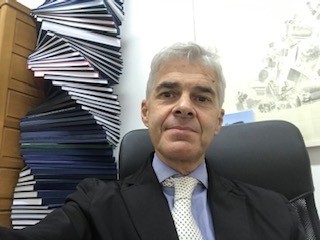
Professor Massimiliano FABBRICINO
is full professor of Environmental Engineering at the University of Naples Federico II. His research topics are related to water and wastewater treatment, solid remediation, waste valorization and circular economy. He has authored more than 150 publications on International Journals, and almost 50 publications on Conference Proceedings. He has been visiting professor at the University of Washington (Seattle – USA), and at the University of Chengdu (Chengdu – China) several times, and has participated, and still participate, to numerous European and National Research projects, often holding the role of Principal Investigator of the local research unit. He got the Fulbright Scholarship for research, the endowed professorship of the University of Washington, and the Italian prize of Fondazione Cortese and Commerce Chamber.
Keynote lecture on: ,,Effects of climate changes on wastewater characteristics in rural areas’’
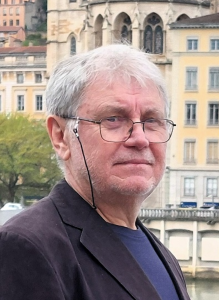
Emeritus Professor Corneliu Balan
graduated mechanical engineering from NUST Politehnica Bucharest in 1981. He obtained a PhD in continuum mechanics at TU Darmstadt (DAAD fellowship 1990 – 1991), a COST post-doc fellowship at University of Wales at Aberystwyth (1993) and a Fulbright Senior Researcher fellowship at University of Minnesota (1994-1995). Corneliu Balan occupied the position of professor in fluid mechanics at Politehnica Bucharest (1996 – 2021), invited professor at TU Darmstadt (1999 – 2014) and visiting scientist at Claude Bernard University Lyon (2004 – 2005).
Corneliu Balan founded in 2000 the REOROM group at Politehnica Bucharest, an unit focused on developing research in non-Newtonian fluid mechanics and rheology. He is co-founder and vice-president of the Romanian Society of Rheology (since 2009), an active member of the European Society of Rheology and International Committee of Rheology. He organized numerous summer schools with the aim to promote rheology in Romania and to establish scientific connections between Romanian institutions and research groups from EU and USA.
Scientific activity of Corneliu Balan was mainly focused on four directions: a) rheometry and modelling of yield stress fluids, b) rheology of polymers derived ceramics, c) flow visualizations of complex fluids in confined domains, d) microfluidics and interfacial phenomena.
He also has a constant interest in philosophy and history of science, especially in investigation the influences of the Austrian universities to the evolution of physics, in particular continuum/fluid mechanics, in the first part of the XXth century.
Keynote lecture on: ,,Constitutive Laws in Fluid Mechanics: Historical Overview and Perspectives’’
Keynote lecture on: “From Sunshine to System Stability: Data-Driven Solar Forecasting for Urban Energy and Grid Resilience”

Dr. Xiaolei (Damon) Yuan
is an Assistant Professor (Tenure Track) at LUT University, Finland. His research focuses on thermal management, data center cooling, and building energy systems. Dr. Yuan has published over 85 scientific papers in peer-reviewed journals and conferences, including Renewable and Sustainable Energy Reviews, Energy Conversion and Management, and Energy and Buildings, including an ESI Highly Cited Paper. He has also participated in more than 40 patent applications. His publications have received over 2,100 citations, with an H-index of 24. He is a corresponding member of the REHVA Research and Technical Committee (TRC). He served as Scientific Committee Chair of BuildSim Nordic 2024 and will serve as Vice Chair and Scientific Committee Chair for the SCANVAC Cold Climate HVAC Conference 2027 and the REHVA HVAC World Congress CLIMA 2028.
Keynote lecture on: “Advanced Microchannel Thermal Management for High Heat Flux Energy Systems: From Flow Field Design to Thermo-Hydraulic Optimization”
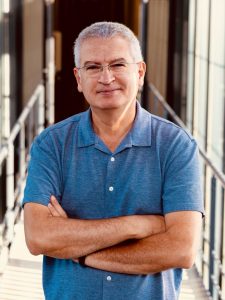
Ph.D. Eng. Daniel Aelenei
is Associate Professor with Habilitation at the Department of Civil Engineering, NOVA School of Science and Technology, Portugal. He coordinates the Master’s Programme in Façade Technology and has extensive experience in teaching, research supervision and international scientific collaboration.
His research focuses on low-energy and net-zero-energy buildings, adaptive and solar-responsive façades, building energy flexibility, passive cooling, passive retrofit strategies and the integration of renewable energy technologies into the built environment.
He has participated in several national and international research projects and networks, including COST Action TU1403 on Adaptive Façades and IEA EBC Annex 67 on Energy Flexible Buildings. He was Principal Investigator of the MIT Portugal FIRST project on mapping the flexibility of urban energy systems. Professor Aelenei has supervised approximately 60 master’s theses and five PhD theses and has authored or co-authored more than 100 scientific publications, including around 80 peer-reviewed journal papers, book chapters and conference proceedings, reflecting his commitment to research, advanced education and the transition towards a resilient, zero-carbon built environment.
Keynote lecture on: “Designing Climate-Adaptive Buildings for Health and Comfort“
DANIELA POPESCU
Daniela Popescu is a lecturer (PhD) at the Faculty of History, University of Bucharest, specializing in contemporary history and international relations. She holds a PhD in History(2020), with doctoral research on Romanian-Turkish relations. She is the author of Navigând în ape învolburate: România și Turcia în vreme de pace și de război (1934–1948) (MegaPublishing House, 2023) and co-author of Post-communism, Democracy, and Illiberalism(Lexington Books, 2023). For the former, she received the 2024 Gheorghe Brătianu Award from the Romanian Society of Historical Sciences (SȘIR).Beyond these books, Daniela Popescu has published extensively on Romanian-Turkishrelations, minority history, and interwar and communist-era propaganda, including “The Escape to Turkey. Ways and Methods of Illegal Border Crossings” (Studia Universitatis Babeș-Bolyai,Historia, 2020), “Perceptions and Misperceptions on Roma People During the First Half of the20th Century” (Review of Ecumenical Studies, 2022), “The German Ethnic Group in Romania’sPropaganda Practices” (Transylvanian Review, 2022), and “The Last Decade Metamorphoses of Türkiye’s Foreign Policy Agenda” (Studia Universitatis Babeș-Bolyai, 2022). Her most recent work, “Celelalte Românii ale presei interbelice: Contrabanda. (i) stupefiante și narcotice”(2026), extends her research into interwar Romanian press and smuggling networks.Daniela founded (2020) and presides over the Cultural Association “Istoria din Casă în Casă”(“History Within Our Homes”), an NGO dedicated to preserving Romania’s 20th-century tangible and intangible heritage — including the country’s first digital archive on 20th-century daily life, documenting family histories and social change.To foster intergenerational dialogue, she launched Romania’s first History Workshops program(2020) in schools, and in 2024 initiated HI-STORY TELLING, a project training teachers to integrate local history into the national communism curriculum, as well as the nationwide Democratic Dialogue: Civic Education and History Workshops project, which now reaches over 5000 pupils a year and aims to counter authoritarian narratives.
KAI LOSER
Kai Löser is the coordinator for digital teaching development at the German School in Belgrade. Previously, he worked on the implementation of Future Skills at the University of Rostock. He studied English, history, philosophy, sociology, and modern German literature at the University of Freiburg and subsequently worked as a research associate and lecturer at Bielefeld University. His research and study visits have included the University of Virginia, Trinity College Dublin, and Yale University. His current work explores media education and the political and ethical dimensions of generative AI.